Starting a business in Texas comes with a remarkable set of advantages — no personal income tax, a business-friendly regulatory environment, a large and growing consumer base, and a culture that genuinely celebrates entrepreneurship. But beyond these well-known advantages, there is another layer of financial opportunity that many Texas startup founders overlook entirely: local tax incentives for Texas startups that are specifically designed to reduce the cost of starting and growing a business in the state. These incentives — offered at the state, county, and municipal level — can translate into significant savings on taxes, property costs, and operational expenses, giving your startup the financial breathing room it needs to invest in growth rather than overhead. At Biyabani International Solutions LLC, we help startups across Dallas, Austin, and Houston identify and take full advantage of local tax incentives for Texas startups, ensuring that our clients never leave money on the table when there are legitimate, available programs designed specifically to support businesses like theirs. Understanding local tax incentives for Texas startups is one of the smartest and most impactful financial strategies any new business owner in this state can pursue.
Why Texas Startup Founders Often Miss Available Tax Incentives
Despite the significant financial benefits they offer, local tax incentives for Texas startups are frequently missed — not because they are difficult to qualify for, but because most startup founders are simply not aware that they exist. The world of tax incentives is complex, fragmented, and constantly evolving, with programs administered at the state level by agencies like the Texas Comptroller of Public Accounts and the Texas Economic Development Corporation, and at the local level by individual counties, municipalities, and economic development corporations with their own eligibility criteria, application processes, and program timelines.
Many Texas startup founders are so focused on the day-to-day demands of building their business that they do not have the time or expertise to research available incentive programs, determine their eligibility, and navigate the application processes required to access them. Others assume that tax incentives are only available to large corporations or businesses in specific industries — not realizing that many local tax incentives for Texas startups are specifically designed for small and early-stage businesses. Working with a professional accounting and tax advisory firm like Biyabani International Solutions LLC is the most reliable way to ensure that your startup is aware of and actively pursuing every incentive program it qualifies for across Dallas, Austin, and Houston.
The Texas Enterprise Zone Program and What It Means for Startups
One of the most significant sources of local tax incentives for Texas startups is the Texas Enterprise Zone Program, administered by the Texas Economic Development and Tourism Office. This program is designed to encourage private investment and job creation in economically distressed areas of the state by providing participating businesses with access to state sales and use tax refunds on qualifying purchases of machinery, equipment, building materials, and other business inputs. For startups that are making significant upfront investments in equipment or facility buildout, the sales tax refunds available through the Enterprise Zone Program can represent a substantial reduction in startup costs.
To participate in the Texas Enterprise Zone Program, a business must be nominated by a local governing body — such as a city or county government — and must meet certain job creation and capital investment thresholds that vary depending on the designation level sought. While the application process requires some effort and planning, the financial benefits for qualifying startups can be considerable. At Biyabani International Solutions LLC, we help Texas startup founders evaluate their eligibility for the Enterprise Zone Program and other similar local tax incentives for Texas startups, guiding them through the nomination and application process to maximize their chances of participation and the financial benefits that come with it.
Learn how our tax services help Texas startups identify and access every available tax incentive program to reduce costs and accelerate growth.
Property Tax Abatements Available to Texas Startups
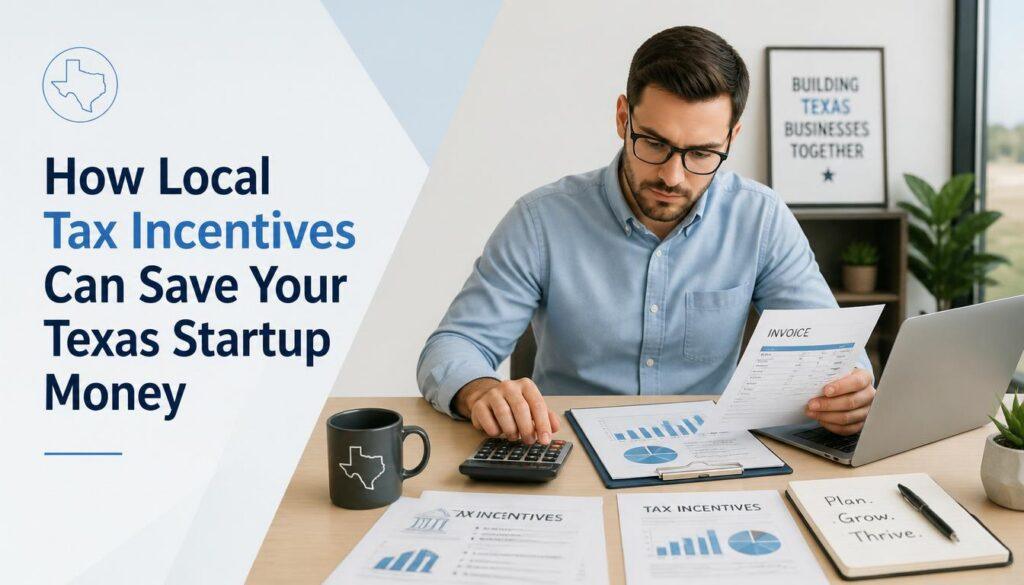
Property tax abatements are another important category of local tax incentives for Texas startups that can generate significant savings — particularly for businesses that are investing in commercial real estate, manufacturing facilities, or other physical infrastructure in Texas. Under Texas law, cities, counties, and other taxing jurisdictions are authorized to offer property tax abatements to businesses that make qualifying investments in their communities, typically in exchange for commitments to create a certain number of jobs or invest a specified amount of capital within a defined timeframe.
Property tax abatements can reduce or eliminate your property tax obligations for a period of up to ten years in some cases, creating a substantial long-term financial benefit for startups that are establishing a physical presence in Dallas, Austin, Houston, or other Texas communities. The specific terms of property tax abatements vary by jurisdiction and are negotiated on a case-by-case basis, which means that the outcome depends heavily on how well the business presents its case to the local taxing authority. At Biyabani International Solutions LLC, we help Texas startup founders understand the property tax abatement landscape in their specific communities and work with them to develop the financial documentation and business case needed to successfully negotiate these valuable local tax incentives for Texas startups.
Research and Development Tax Credits for Texas Innovation Startups
For startups in technology, life sciences, engineering, and other innovation-driven industries, research and development tax credits represent one of the most valuable categories of local tax incentives for Texas startups at the federal level. The federal R&D tax credit — formally known as the Research and Experimentation Tax Credit — allows qualifying businesses to claim a credit against their federal income tax liability for a percentage of their qualified research expenses. For early-stage startups that have not yet achieved profitability, the Protecting Americans from Tax Hikes Act of 2015 made a critical change that allows eligible startups to apply up to two hundred and fifty thousand dollars of their R&D tax credit against their payroll tax liability — making it accessible even to businesses that do not yet owe federal income tax.
Many Texas startup founders in innovation-driven industries are unaware that their day-to-day product development, software engineering, and technical problem-solving activities may qualify as research and development expenses for this credit. The definition of qualifying research is broader than many people assume, and identifying all of the activities and expenses that qualify requires a detailed analysis of your business’s operations and financial records. At Biyabani International Solutions LLC, we help innovation-focused Texas startups identify their qualifying R&D expenses, calculate their available credit, and claim it correctly — turning this underutilized incentive into one of the most impactful local tax incentives for Texas startups in their financial toolkit.
Explore our accounting services and see how Biyabani International Solutions LLC helps Texas startups maximize every available tax credit and incentive program.
Sales Tax Exemptions That Texas Startups Should Be Using
Sales tax exemptions represent one of the most immediately accessible categories of local tax incentives for Texas startups, and yet they are frequently overlooked or misapplied by small business owners who are not deeply familiar with the Texas sales tax code. Texas law provides sales tax exemptions for a wide range of business purchases — including manufacturing equipment and supplies used directly in the production of tangible goods, agricultural inputs and equipment, certain technology and software used in qualifying industries, and goods purchased for resale rather than direct consumption. Qualifying for and correctly applying these exemptions can reduce your business’s sales tax burden significantly, freeing up cash that can be reinvested in growth.
Claiming a sales tax exemption in Texas typically requires obtaining and presenting a properly completed Texas Sales and Use Tax Exemption Certification to your vendors at the time of purchase. Businesses that fail to obtain this documentation may end up paying sales tax on purchases that should have been exempt — and recovering those overpayments after the fact can be a time-consuming and uncertain process. Working with a knowledgeable tax advisor who understands the full range of local tax incentives for Texas startups — including available sales tax exemptions — is the most reliable way to ensure your startup is not paying more sales tax than it legally owes. Biyabani International Solutions LLC helps Texas startups across Dallas, Austin, and Houston identify their applicable exemptions and implement the documentation processes needed to claim them correctly every time.
Economic Development Incentives Offered by Texas Cities and Counties
Beyond state-level programs, many Texas cities and counties offer their own economic development incentives that represent valuable local tax incentives for Texas startups looking to establish or expand their operations in specific communities. Dallas, Austin, and Houston each have active economic development programs that offer a range of financial incentives — including grants, forgivable loans, infrastructure improvements, and fee waivers — to businesses that create jobs, invest capital, and contribute to the economic vitality of the community. These programs are often administered by local economic development corporations that have discretionary authority to negotiate incentive packages on a case-by-case basis.
Accessing these local economic development incentives requires proactive engagement with the relevant local authorities — researching available programs, understanding their eligibility criteria, and presenting a compelling case for why your startup deserves support. Many startup founders do not pursue these opportunities simply because they do not know they exist or do not know how to navigate the application process. At Biyabani International Solutions LLC, we stay current on the economic development incentive landscape across Dallas, Austin, and Houston, and we actively help our clients identify and pursue the local tax incentives for Texas startups that are available in their specific communities — because we believe that every dollar of legitimate incentive your business can access is a dollar that can be invested in your growth instead.
How to Qualify for and Claim Texas Startup Tax Incentives
Understanding that local tax incentives for Texas startups exist is only the first step — the more important challenge is actually qualifying for and successfully claiming them. The qualification process varies significantly by program and by incentive type, but there are several common elements that apply across most programs. These include demonstrating that your business meets the program’s eligibility criteria — which typically relate to industry, size, job creation commitments, and investment levels — providing accurate and detailed financial documentation that supports your application, and in many cases negotiating the specific terms of the incentive with the relevant government authority.
Having accurate, professionally maintained financial records is essential for this process, because most incentive programs require detailed financial documentation to support your application and to verify your compliance with program requirements after the incentive is granted. This is one of the many ways in which good bookkeeping and professional accounting support directly translate into financial benefits for Texas startups — because without reliable financial records, accessing local tax incentives for Texas startups becomes significantly more difficult and uncertain. At Biyabani International Solutions LLC, we provide the integrated bookkeeping, accounting, and tax advisory support that gives our clients the financial documentation and strategic guidance they need to successfully access every incentive program available to them.
Discover how our bookkeeping services help Texas startups maintain the accurate financial records needed to qualify for and claim local tax incentives successfully
Working With a Professional to Maximize Your Incentive Opportunities
The landscape of local tax incentives for Texas startups is complex, constantly evolving, and highly specific to your business’s industry, location, size, and growth plans. Navigating this landscape effectively requires a level of knowledge and experience that most startup founders simply do not have — and trying to research and pursue incentive programs on your own while also running a business is rarely the best use of your time or energy. Working with a professional accounting and tax advisory firm that specializes in Texas small businesses and startups is the most reliable and efficient way to ensure that your business is capturing every incentive opportunity available to it.
At Biyabani International Solutions LLC, we make it our business to stay current on the full range of local tax incentives for Texas startups available across Dallas, Austin, and Houston — and to proactively match our clients with the programs they qualify for. Our team combines deep technical tax knowledge with practical experience navigating the incentive landscape in Texas, giving our clients a genuine competitive advantage when it comes to reducing their tax burden and maximizing the financial resources available for growth. If you are a Texas startup founder who wants to ensure you are taking full advantage of every available incentive, we are ready to help you get started today.
According to the Texas Economic Development and Tourism Office, Texas offers a wide range of business incentive programs designed to encourage investment and job creation across the state.
Frequently Asked Questions
What are local tax incentives for Texas startups and how do they work?
Local tax incentives for Texas startups are programs offered by state, county, and municipal governments that reduce the tax burden on qualifying businesses in exchange for commitments to create jobs, invest capital, or operate in specific industries or locations. They can take the form of tax credits, tax abatements, sales tax exemptions, grants, or forgivable loans, and they are designed to make it more financially attractive for businesses to start and grow in Texas communities. Working with a professional tax advisor is the most effective way to identify and access the programs your startup qualifies for.
Does my Texas startup need to be in a specific industry to qualify for tax incentives?
Not necessarily. While some incentive programs — such as the R&D tax credit — are more relevant to innovation-driven industries, many local tax incentives for Texas startups are available across a wide range of industries and business types. Property tax abatements, sales tax exemptions, and economic development incentives, for example, are available to businesses in many different sectors. The eligibility criteria vary by program, which is why working with a knowledgeable tax advisor who can evaluate your specific situation is so important.
How do I find out which tax incentives my Texas startup qualifies for?
The most reliable way to identify the tax incentives your startup qualifies for is to work with a professional accounting and tax advisory firm that specializes in Texas businesses. At Biyabani International Solutions LLC, we conduct a thorough review of each client’s business profile, industry, location, and financial situation to identify every applicable incentive program — and then help them navigate the qualification and application process to access those benefits successfully.
Can I claim the R&D tax credit if my Texas startup is not yet profitable?
Yes — eligible startups that have not yet achieved profitability may be able to apply a portion of their R&D tax credit against their payroll tax liability rather than their income tax liability, thanks to provisions in the Protecting Americans from Tax Hikes Act. This makes the R&D tax credit one of the most valuable local tax incentives for Texas startups in innovation-driven industries, even in the early pre-profitability stage when cash is most scarce and every financial benefit matters most.
How does Biyabani International Solutions LLC help Texas startups access tax incentives?
Biyabani International Solutions LLC helps Texas startups identify every available tax incentive program they may qualify for, evaluate their eligibility in detail, prepare the financial documentation required for applications, and navigate the qualification and claiming process from start to finish. We also ensure that our clients maintain the accurate financial records and ongoing compliance required to retain their incentive benefits over time. Our goal is to ensure that every Texas startup we serve captures the full financial benefit of every incentive available to them across Dallas, Austin, and Houston.